A treatment result needs a calendar. Before interpreting a percentage, ask when observation began, when it ended, and what happened between those dates. A summary may describe a useful slice of experience while leaving the beginning of treatment almost invisible. That distinction matters when the practical question is how to assess progress rather than how to admire a large bar on a chart.
This article develops an editorial interpretation of the research, with fictional arithmetic examples to make the measurement choices visible. For men over 50, the aim is to turn a group result into better questions for an appointment. It is not a timetable for an individual erection, a required number of attempts, or a reason to change a prescription.
The reported measurement
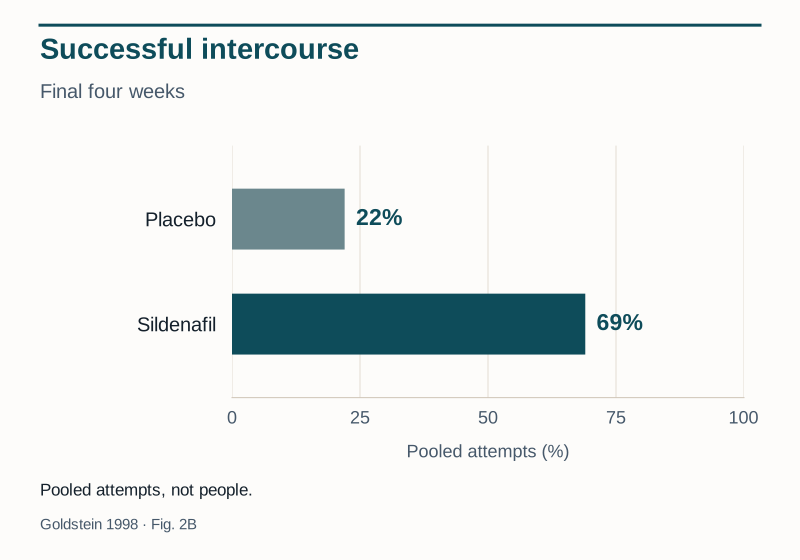
| Group | Percent |
|---|---|
| Placebo | 22% |
| Sildenafil | 69% |
Download: SVG chart · PNG chart · CSV data
What the comparison was built to answer
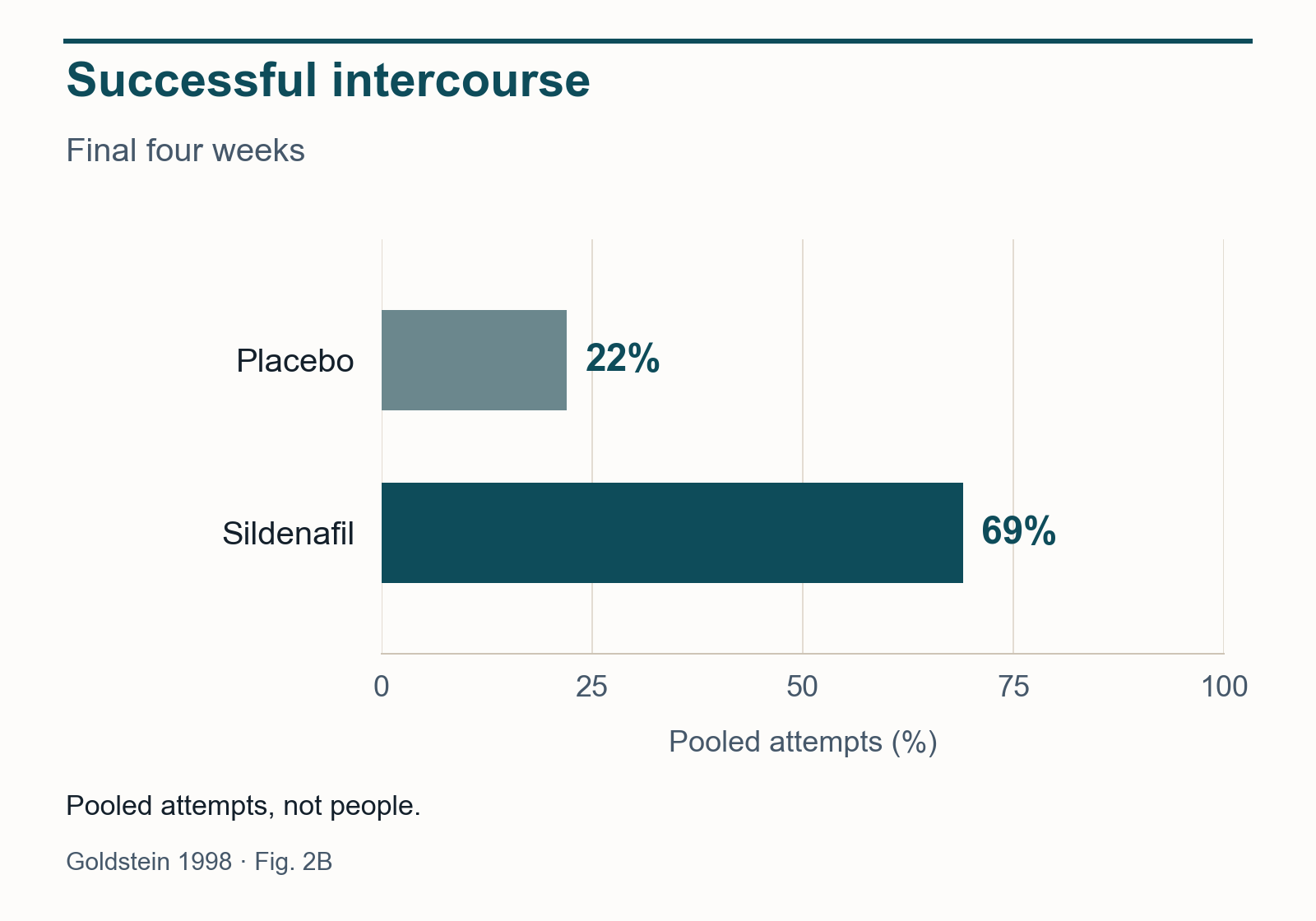
A randomized, double-blind trial compared adjustable oral sildenafil (25–100 mg) with placebo in 329 men with ED over 12 weeks. Questionnaire endpoints assessed penetration and erection maintenance; the chart pools final-four-week intercourse attempts.
Random assignment is useful because choosing a treatment for yourself can be connected to your expectations, symptoms and willingness to keep trying. Allocation by chance aims to separate those influences from the assigned treatment. It does not make every individual in one group identical to someone in the other. Blinding adds a different protection: concealing assignment reduces the opportunity for expectations about the assigned product to shape reporting or assessment.
Our interpretation is that a controlled comparison should be read as an answer to a defined research question. It is not a personal forecast waiting to be uncovered by looking harder at the bars. A questionnaire and an event record also describe different aspects of experience: a broader remembered assessment need not be numerically interchangeable with a record of particular encounters. Our guide to discussing ED with a doctor can help organize questions about which kind of change matters to you.
Sources: 1
Separate the calendar from the stopwatch
Consider three clocks in a hypothetical study. One runs from enrollment to the final assessment. Another selects which diary entries contribute to an outcome. A third starts when a dose is taken and measures elapsed time before an event. Those clocks can overlap, but none can automatically stand in for another. Knowing the length of a study does not identify the delay between dosing and response.
A late observation window can be useful when the research question concerns experience after some time in treatment. Its usefulness does not reveal what happened earlier. To study the beginning, researchers would need appropriately timed observations near the beginning. To study dose-to-event timing, they would need relevant timestamps and a clear definition of the event being timed. These are different data requirements, not competing opinions about one statistic.
The table is an original reading aid. It explains why a calendar phrase should remain attached to the result it describes. Our overview of treatment timing offers broader orientation; the clocks below are a method for checking whether any specific timing claim actually follows from its evidence.
| Clock | Question it asks | Information needed |
|---|---|---|
| Study calendar | How long was the research conducted? | Enrollment and assessment dates |
| Outcome window | Which period contributed events? | Rules selecting the records |
| Dose-to-event clock | How much time elapsed before an event? | Dose/event timestamps and an event definition |
Whose experience gets the most weight?
The denominator is the set of observations placed underneath the successes in a fraction. If all attempts are combined first, each attempt has equal numerical weight. A participant contributing many entries then influences the combined percentage more than someone contributing only a few. That is an arithmetic property, not evidence that either person matters more clinically.
Here is a fictional example unrelated to either trial. Record A contains three successes among four attempts. Record B contains three among twenty attempts. Pooling produces six successes among twenty-four attempts, or 25%. Averaging the two individual percentages produces 45%. Both calculations are correct; they answer different questions. The first describes a randomly selected recorded attempt. The second gives equal weight to each of the two records.
Neither calculation tells us how often a newly assessed person will succeed. Such a prediction requires information about that person and evidence that the prediction works in relevant patients. The distinction is explored from the other direction in our daily tadalafil study analysis. Reading the denominator before comparing charts prevents an arithmetic difference from being mistaken for a clinical advantage.
| Fictional record | Successful / attempted | Individual percentage |
|---|---|---|
| A | 3 / 4 | 75% |
| B | 3 / 20 | 15% |
| Both records | 6 / 24 pooled | 25% pooled; 45% equal-person mean |
A total erases the order of events
Imagine two fictional logs containing eight attempts apiece, with four successes in each. In one, all the successes occur first. In the other, they occur last. The overall fraction is identical even though the sequence is reversed. A third log could alternate success and failure throughout. A single percentage cannot identify which of those patterns occurred.
This is why a summary should not be stretched into a claim about steady improvement, an early plateau or waning benefit. Those are descriptions of change over time. They need observations arranged by time, with enough detail to distinguish a real pattern from ordinary variation. Drawing a rising line between a starting point and an ending point adds a story that the intervening records would have to support.
Our interpretation is to ask for the shape of the evidence whenever the claim itself has a shape. Words such as gradually, immediately, consistently and permanently each imply a pattern. A percentage may be perfectly accurate while providing too little information to justify those words. The question is not whether a result is impressive; it is whether the measurement can resolve the particular time pattern being claimed.
Sources: 1
An unrecorded event is not a known failure
A diary summary begins with observations, but it cannot explain every absence. No entry might mean that no attempt occurred, that an attempt was forgotten, that reporting stopped, or something else. These possibilities have different meanings. Treating all blanks as failures invents outcomes. Treating every blank as harmless can also be misleading if missingness is connected to the experience being measured.
An original way to examine the problem is to imagine three separate ledgers: who remained under observation, who contributed usable entries, and how many entries each person contributed. Those ledgers can diverge. A person may attend an assessment without providing an event log, while another may contribute entries without completing every questionnaire. One headline enrollment count cannot resolve every denominator.
For a sensitivity analysis, researchers ask whether reasonable alternative assumptions about unavailable observations would change the conclusion. This does not recover the missing truth; it tests how dependent an answer is on assumptions. Here, no missing outcomes are reconstructed. The useful reading question is which records support the displayed result and what uncertainty remains about experience outside those records. A blank space should stay a question until evidence gives it meaning.
Sources: 1
Why improvement needs a comparison group
A before-and-after change combines everything that happened between assessments. In a hypothetical treatment study, that could include the intervention, changing expectations, ordinary variation, altered circumstances, or measurement error. Observing improvement after treatment begins is therefore not the same as isolating improvement caused by treatment. A contemporaneous comparator helps researchers ask what would have happened under another assigned condition.
That reasoning does not make a placebo response imaginary. A reported outcome remains an observation, whatever combination of influences produced it. The scientific task is to compare groups under the study conditions, not to explain every control-group event with one psychological label. Without measurements designed to separate mechanisms, a numerical difference cannot tell us precisely how much of the experience came from each possible influence.
Our interpretation is that two questions deserve separate answers: whether the assigned intervention changed the measured outcome, and what a participant experienced overall. The first requires a defensible comparison. The second may involve satisfaction, inconvenience or priorities beyond the selected outcome. An evaluation can be strong for one question and incomplete for the other. Keeping those questions separate improves the meaning of a favorable result without diminishing it.
Sources: 1
Precision is more than the number of entries
Many events do not necessarily mean many independent pieces of information. Repeated observations from one person share circumstances that observations from different people may not share. In statistical language, they can be correlated. If an analysis treats closely related entries as though they came from unrelated individuals, its apparent precision can be overstated.
A confidence interval describes uncertainty around an estimate under an analysis and its assumptions. It is not a guarantee about the next person. Nor can an appropriate interval be reconstructed simply by reading rounded percentages from a chart. The relevant counts, dependence between observations, missing-data handling and model all matter. No interval is calculated here from the displayed bars.
Statistical significance addresses a different question from the size or usefulness of an effect. A result can be estimated precisely yet leave personal priorities unanswered. Conversely, a noisy estimate may reflect too little information rather than proof that no difference exists. Our reading approach is to ask about direction, magnitude, precision and applicability separately. Those four questions are more informative than asking a single number to carry the entire conclusion.
Sources: 1
Continued benefit and lasting change require different tests
Suppose a fictional intervention is assessed repeatedly while it continues. Stable favorable measurements would support an account of experience during continued treatment. They would not, by themselves, establish what happens after treatment stops. A claim of lasting change needs observations made under conditions relevant to that claim, including a defensible approach to follow-up and other treatments.
Selection matters when interpreting longer observation. If only some participants continue, their later experience may not represent everyone who originally entered. People can leave research for many reasons, and it would be unjustified to assign a reason without records. The methodological question is how the later group was formed and whether its comparison conditions remain informative.
Our interpretation is to distinguish persistence of observation from persistence of an effect. A longer calendar is valuable only in relation to what was measured along it. For an appointment, a useful question is what information would prompt reassessment of the current plan, rather than selecting a deadline from a paper. The guide to what happens at an ED appointment provides context for that discussion; it does not turn research follow-up into a personal stopping rule.
Sources: 1
Matching a claim to the product actually evaluated
Evidence matching is another scientific question. A claim about a finished product needs a reason to connect that product with the research. Sharing an ingredient name does not itself establish matching formulation, exposure, regimen or outcome. Our editorial interpretation is that each changed feature creates a question to investigate, rather than an automatic conclusion that the new product performs better, worse or identically.
FDA explains that compounded medicines are not FDA approved and do not undergo its premarket review for safety, effectiveness and quality. Compounding can meet an individual medical need. Those facts do not establish the performance of every preparation. Equally, an ingredient study cannot fill every gap in the evidence for a different finished preparation simply because the ingredient appears on both labels.
Documentary questions can be kept concrete: what formulation is described, what information is available about the prescription process, and where are the relevant terms stated? Our online treatment questions guide can help organize that reading. The Rex MD review and Lemonaid Health review are places to inspect documentary terms. These links make no claim about trial-equivalent products, clinical outcomes or the quality of an individual consultation.
A favorable chart cannot settle a safety decision
Headache, flushing and indigestion were reported. A benefit measure and an adverse-event assessment address different questions. Even if a symptom appears manageable in a research report, its importance to an individual depends on circumstances that a group summary cannot supply. The absence of a particular event from a small sample would also leave uncertainty about uncommon harms.
Current Viagra labeling prohibits nitrates and riociguat. Safe nitrate timing is unknown even at 24 hours. An erection lasting over four hours needs emergency care; sudden vision or hearing loss means stopping the medicine and seeking prompt care. Chest pain, dizziness or nausea during sex means stopping activity and obtaining immediate help; tell emergency clinicians about recent use. Cardiovascular status, kidney/liver function and interacting medicines require assessment. Do not self-combine ED medicines.
Our interpretation is that efficacy evidence and prescribing safeguards must travel together without being substituted for each other. A research percentage cannot supply clearance for an interaction, and a clock cannot make that clearance a home decision. The appropriate scientific conclusion can acknowledge a treatment benefit while leaving individual eligibility, follow-up and emergency decisions with the clinicians responsible for that care.
Editorial assessment
Our assessment is that the most useful reading preserves the question each measurement was designed to answer. Start with the observation window, identify the counted unit, and preserve the distinction between a group comparison and an individual timeline. Claims about onset, consistency and persistence require their own evidence. A careful reading therefore leads to specific follow-up questions: which experience matters, which observations could assess it, and which decisions require current prescribing information. That approach makes a research result useful without asking it to predict a private calendar.
Evidence limits
Full paper retained; fresh access blocked (403). Protocols, supplements, individual data unreviewed. Pfizer funded and supported design/analysis; investigators disclosed Pfizer consulting. Fictional examples explain arithmetic and measurement; they do not reconstruct trial data. This is editorial scientific interpretation, not a claim of clinician review.
Questions about the evidence
Can a late observation window tell me when treatment first started helping?
It cannot locate the first change without observations that resolve that question. In an original analogy, a photograph taken near the end of a walk shows where someone was then, not when each earlier turn occurred. For research, the missing information is a sequence of appropriately timed measurements, not a more enthusiastic reading of the final summary. 1
Why can two correct percentages describe the same records differently?
The order of calculation determines who receives weight. Combining all events emphasizes records with more events. Calculating each person’s percentage first and then averaging gives people equal weight. Neither arithmetic rule supplies a personal prediction. Before comparing results, identify the unit being counted and the research question that made that unit useful. 1 2
Does a study result tell me how many attempts I should make before reassessment?
No universal attempt threshold is derived here. A research schedule is designed to collect comparable information across participants. An individual review also has to account for the reason for treatment, the prescribed plan, symptoms and safety concerns. The methodological lesson is to agree what information is useful for review, rather than borrowing a count from unrelated research procedures. 1 3
Would a larger study remove every uncertainty?
More information can improve precision, but it cannot repair a mismatch between a question and its measurement. A very large collection of untimed events still cannot identify exact onset. Likewise, adding more participants does not automatically answer what happens after observation ends. Size, design and relevance contribute different parts of a trustworthy answer. 1
What should I check before accepting a claim about lasting benefit?
Ask what lasting means, when it was measured and under which treatment conditions. Then ask who contributed the later observations and what comparison remained available. This is an evidence checklist, not a recommendation to stop treatment as an experiment. A claim becomes more interpretable when its calendar and conditions are explicit. 1 3
References
- Study. Goldstein 1998.Checked 2026-10-24. Full paper.
- Study. Porst 2006.Checked 2026-10-24. Full paper.
- Current prescribing information. VIAGRA (sildenafil citrate) US prescribing information.Checked 2026-10-24.
- Current prescribing information. Cialis (tadalafil) prescribing information.Checked 2026-10-24.
- FDA public information. Understanding the risks of compounded drugs.Checked 2026-10-24.